
Last Updated on January 30, 2024 by Ibrahim Bat
Chemex and Hario V60 are quite popular coffee brewing equipment among coffee enthusiasts. Although they might seem similar initially, they have quite pronounced differences. This article will spotlight these two popular pour-over coffee makers, highlighting their similarities and differences. You will also find the answer to the question, “Which one is best for you?” within this article.
What is a Chemex?
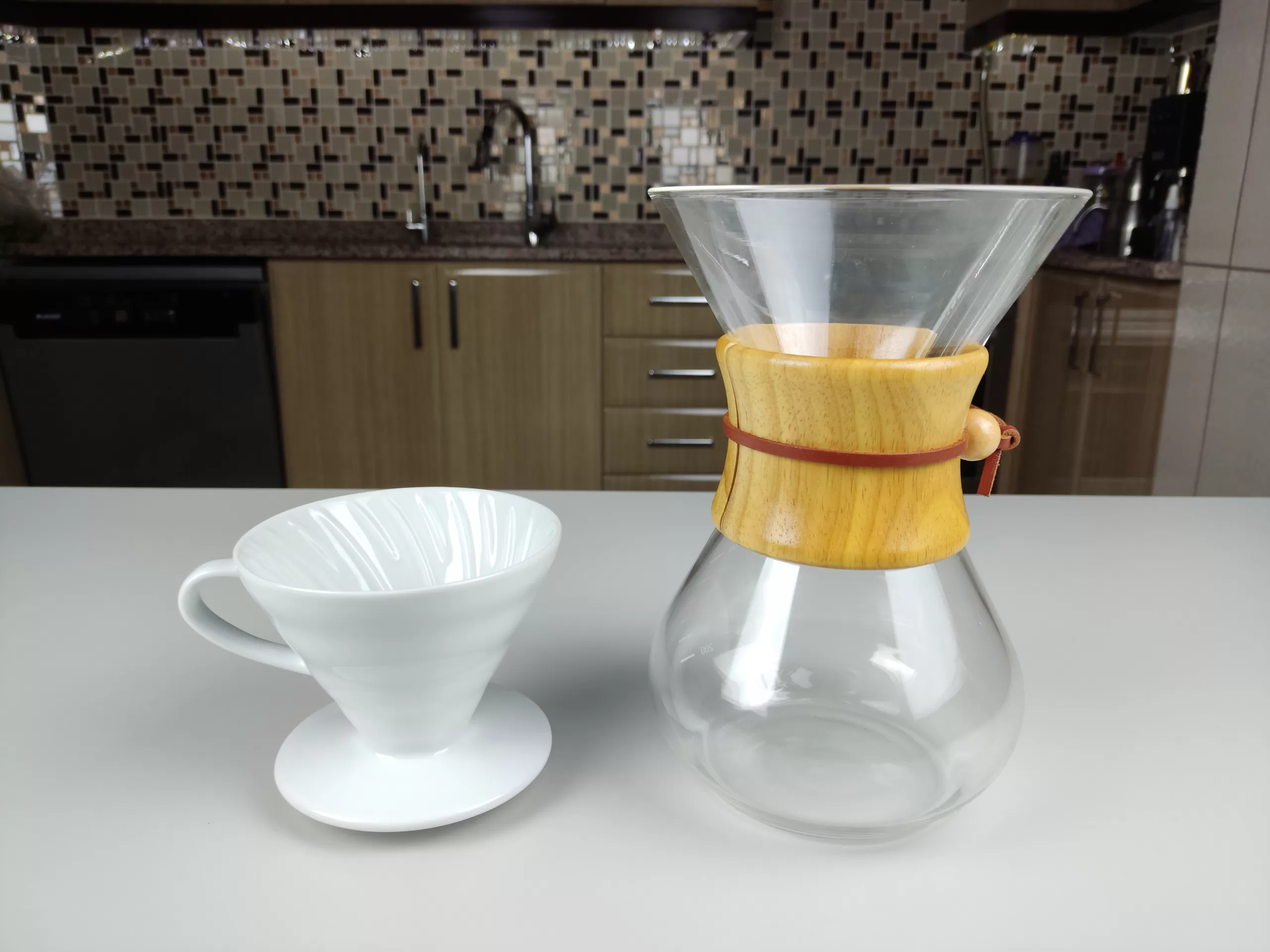
Chemex is a manual pour-over brewer with the appearance of a ribbed glass vase. To handle the heated pitcher during brewing, it has a wooden collar around its pinched waist, tied with a leather band. Many people who see the Chemex for the first time assume it looks like a piece of laboratory equipment. In a way, they’re right. The Chemex was designed in 1941 by chemist Peter Schlumbohm. Laboratory equipment was an inspiration for him while crafting this design.

What is a Hario V60?
The Hario V60 is a manual pour-over brewer preferred by baristas worldwide. The name V60 comes from its cone shape, and its walls rise at a 60-degree angle. “Hario” is the name of the Japanese company, which means “King of Glass” in Japanese. It resembles a cone-shaped cup with a hole at the bottom. It has spiral ribs on its side walls to facilitate water flow.

Chemex and Hario V60: Similarities and Differences
There are many similarities and differences between the Chemex and Hario V60. I can’t say one is better, but depending on the purpose of use, each product has various advantages and disadvantages.
General Design
Many people consider the Chemex as one of the most elegant coffee equipment. However, as someone who owns a Chemex and a V60, I must say that I find both quite stylish. After all, beauty is a very subjective concept. I am leaving photographs of Chemex and Hario V60 here. Look and let me know in the comments which one you find more appealing.
One of the most noticeable design differences is that while the Chemex comes with its server, you need to buy a separate coffee server for the Hario V60. If you haven’t purchased it yet, you can buy the Hario V60 as a set with the server. I also want to mention this: If you’re going to brew single servings with the Hario V60, you can place the V60 directly on your cup. That’s how I do it for single brews 😊. However, you might need a coffee server to brew more than one serving.

Funnel Design
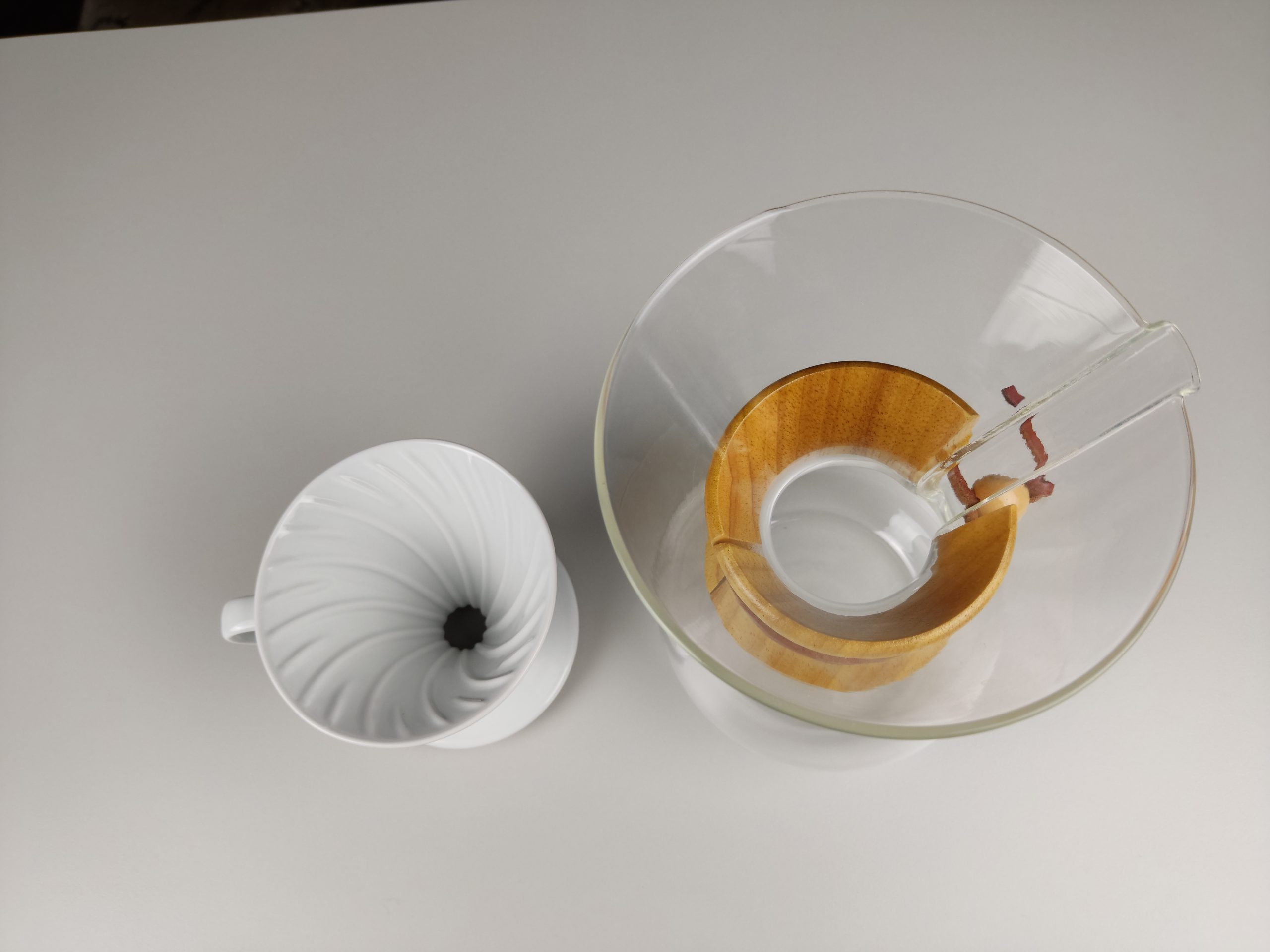
The Hario V60 cone has ribs inside it. On the other hand, the funnel part of the Chemex does not have any ribs or grooves. It has a smooth structure.
When you place and wet the paper filter in the Chemex, the paper filter sticks to the Chemex. This ensures that the water poured exits not from the sides but from the bottom of the funnel during brewing.
In the Hario V60, the ribs on the sides create a gap between the paper filter and the V60 funnel. This allows the brewed filter coffee to exit from the edges of the paper filter.
This design helps water disperse evenly over the coffee grounds, resulting in a more consistent extraction.
Size
Regarding brewing capacity in a single go, the Chemex can brew coffee in a larger volume. On the other hand, there are also smaller-capacity versions of the Chemex.
Both the Chemex and Hario V60 specify capacities in cups. 1 cup is considered to be 4 fl oz (120 ml).
The table below shows the maximum coffee amount the Chemex and Hario V60 models can brew.
| Model | Cup | Metric (ml) | Imperial (fl oz) |
|---|---|---|---|
| Hario V60 01 | 2 Cup | 240 ml | 8 fl oz |
| Hario V60 02 | 4 Cup | 480 ml | 16 fl oz |
| Hario V60 03 | 6 Cup | 720 ml | 24 fl oz |
| Chemex 3 Cup | 3 Cup | 360 ml | 12 fl oz |
| Chemex 6 Cup | 6 Cup | 720 ml | 24 fl oz |
| Chemex 8 Cup | 8 Cup | 960 ml | 32 fl oz |
| Chemex 10 Cup | 10 Cup | 1200 ml | 40 fl oz |
The 6 and 8-cup Chemex models are generally used for making coffee at home. On the other hand, the 3-cup model looks a bit different from the iconic Chemex design. It has a narrow and elongated funnel.
Model and Material
Chemex has two different models. The first is the most known, with a natural wooden collar tied with a rawhide band. The other model has a glass handle. Chemex is made from borosilicate glass, and no version is made from a different material. For the Hario V60, it’s the opposite. There’s only one model, but it’s available in several materials.
The following models of Hario V60 are available:
- ceramic
- copper
- metal
- plastic
- glass
Among these models, the most iconic is the white ceramic model (which I also use).
Durability and Portability
When it comes to durability, the Hario V60 clearly feels more robust. You must be careful when using the Chemex, as it feels delicate and easily breaks. In terms of portability, the durable Hario V60 is more portable.
However, you should be more cautious with the glass and ceramic models. If you don’t want to leave it to chance, you can opt for plastic, copper, or metal models.
To be frank, I sometimes carry my ceramic Hario V60 with me. I wrap it in a scarf and have had no problems carrying it in my backpack or suitcase. However, I can’t say the same for the Chemex. It’s not suitable for traveling or camping trips.
You can check today’s price by clicking on the relevant places from the table below.
Chemex | Hario V60 |
Filter
Both Chemex and Hario V60 use paper filters. However, these filters are quite different from each other.
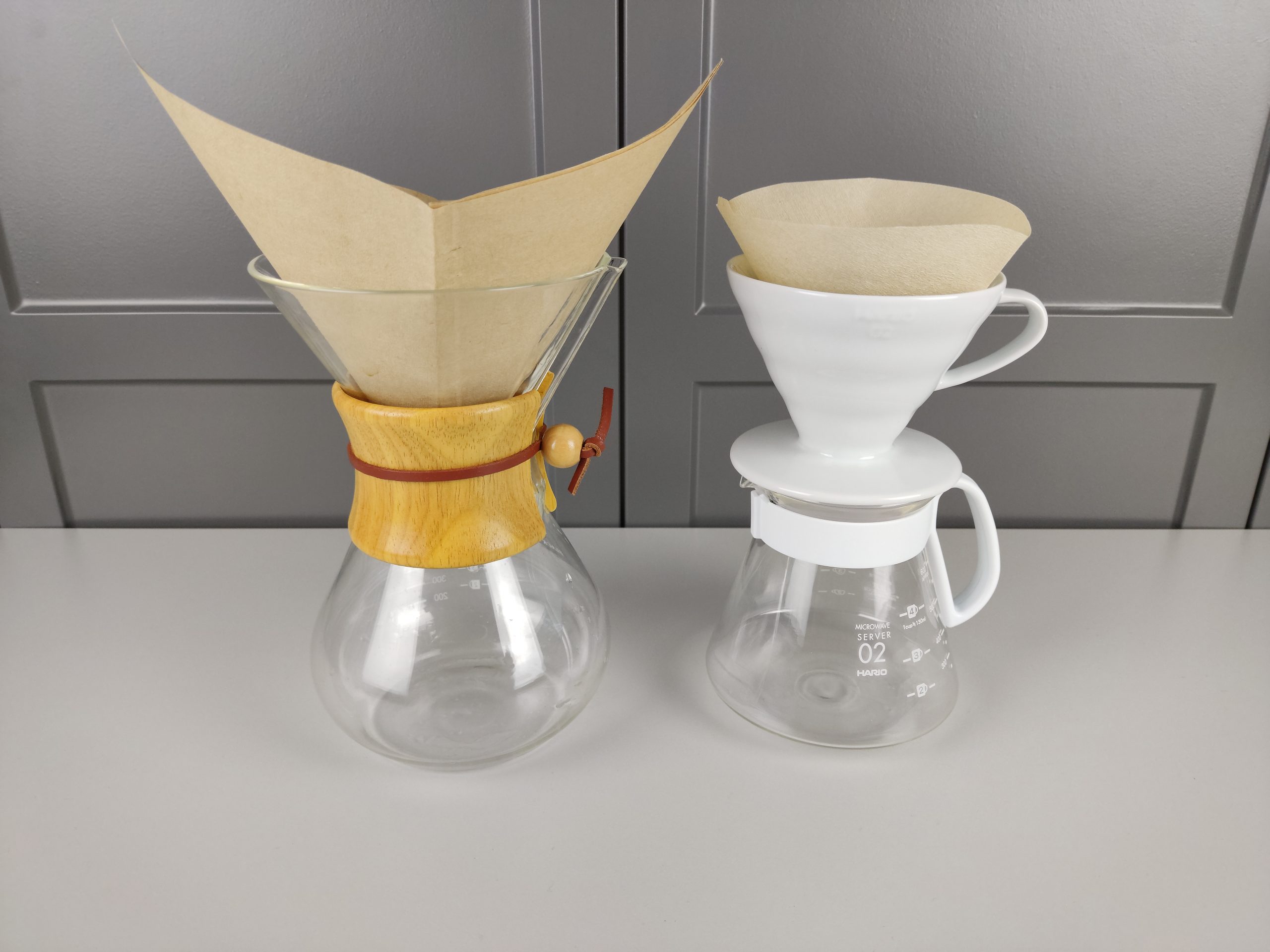
The Chemex filter is significantly larger, thicker, and heavier than the Hario V60 filter. The Chemex paper filter I currently use weighs 4.5 grams, while the Hario V60 filter weighs 1.5 grams.
There are natural and oxygen-bleached paper filters available for both models. You can choose between them based on your preference. If you want to minimize the taste of the paper filter in your cup, I recommend using the oxygen-bleached paper filter.
I should also note that paper filters are single-use. Therefore, they represent a recurring cost. At this point, I should mention that Chemex paper filters are more expensive than Hario paper filters.
Additionally, there are stainless steel filters available for both Chemex and Hario V60. These filters can be reused. I wanted to drop this information here but I do not recommend these stainless steel filters. This is because they don’t filter as well as paper filters. Ultimately, your coffee will be cloudy with fines, and silty sludge will be at the bottom.
Grind Size
The grind size used for Chemex and Hario V60 is different. The reason is the difference in the paper filters used.
As I mentioned earlier, the paper filter for Chemex is thicker. This creates resistance to the flow of water. Therefore, to balance the brewing time, a coarser grind is used.
While a medium-coarse grind size is used for Chemex, a medium-fine to medium grind size is used for Hario V60.
Flavor Profile
Firstly, I must clearly say that both coffee equipment produce truly tasty coffees. Although there isn’t a huge difference in taste, a slight distinction can be felt.
Since the Chemex’s paper filter is thicker, it filters out more coffee oils. As a result, the coffee from Hario V60 is somewhat denser and has more body.
Ease of Use and Maintenance
When it comes to ease of brewing, Chemex might seem a bit simpler. With Hario V60, you might need a bit more expertise. This is because the structure and filter of the Hario V60 allow the water to drain faster.
With the Hario V60, you’ll need to improve on pouring the water. But don’t worry too much. With some practice, you can master it.
The Hario V60 is by far the easiest in terms of maintenance ease. You can clean every part of the product by scrubbing, but reaching inside the Chemex’s chamber might be difficult unless you have a small hand.
On the other hand, because the Chemex is big, there’s a greater risk of knocking it against something while cleaning. And since Chemex is very delicate, knocking it can easily break it.
Chemex vs. Hario V60: Which one is best for you?
| Feature | Chemex | Hario V60 |
|---|---|---|
| Design | Elegant, comes with its server. | Requires separate server; can be placed on a cup. |
| Funnel Design | Smooth, no ribs. Filter sticks, water exits from the bottom. | Ribs inside; coffee exits from filter edges. |
| Size (Examples) | 3 Cup: 360ml, 6 Cup: 720ml | 01: 240ml, 02: 480ml, 03: 720ml |
| Model & Material | Two designs (wooden collar or glass handle). Borosilicate glass. | Multiple materials (ceramic, copper, metal, plastic, glass). |
| Durability | Delicate and easily breaks. | Feels robust; glass and ceramic models need care. |
| Portability | Not suitable for traveling. | More portable, especially non-glass models. |
| Filter | Thicker, weighs around 4.5 grams. More expensive. | Lighter, weighs around 1.5 grams. Less expensive. |
| Grind Size | Medium-coarse. | Medium-fine to medium. |
| Flavor Profile | Less dense due to thick filter. | Denser with more body due to thinner filter. |
| Ease of Use | Simpler brewing process. | Requires more technique due to faster water drain. |
| Maintenance | Harder to clean, especially inside. Risk of breakage. | Easier to clean every part. |
I tried to cover the Chemex and Hario V60 in this guide in all their details. Frankly, I love the coffee made by both. Both Chemex and Hario V60 produce high-quality coffees.
However, brewing just for one person with Chemex feels a bit wasteful. I have to use a large paper filter for a single serving. If you have environmental concerns and are making single servings, Hario V60 might be a better choice.
On the other hand, brewing coffee with Chemex for a group of friends looks cool.
Lastly, whether you buy Chemex or Hario V60, I strongly recommend getting a Gooseneck kettle. It will significantly help you improve your technique.