
Last Updated on January 27, 2024 by Ibrahim Bat
Coffee lovers often enjoy cold brew for its smooth and cool taste. But making cold brew takes a long time, often many hours. Also, some people think cold brew isn’t strong enough in flavor.
Luckily, in this recipe from Best Coffee at Home, I will introduce you to a Japanese-style iced coffee recipe that addresses all the issues of cold brew.
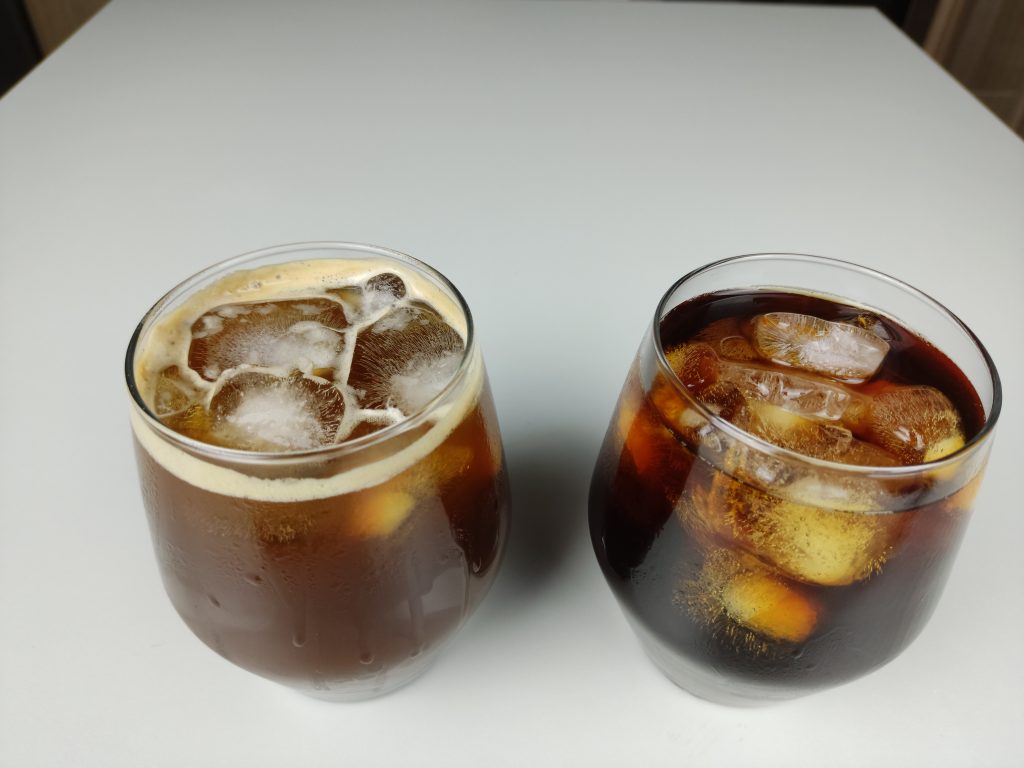
Japanese iced coffee offers a taste similar to cold brew but with the added benefit of not requiring hours of brewing time. Moreover, it allows you to adjust the coffee’s strength to your preference. So you can tailor it to your liking and enjoy a perfectly balanced cup of coffee.
What Makes Japanese Iced Coffee Different?
When brewing coffee with cold water, some of the characteristic features of the coffee beans may be lost. While cold brew coffee can still result in a satisfying cup of coffee. If you want to extract the origin characteristics of the coffee you’ve purchased more effectively, it’s better to use hot water. This is because brewing coffee with cold water may not extract the coffee sufficiently.
One solution is to brew your coffee with hot water and wait for it to cool. However, this method often produces a bitter and stale cup of cold coffee. Another solution is to cool your filter coffee by adding ice, but the melting ice dilutes the coffee and results in a soft cup.
Japanese iced coffee is a perfect brewing method that offers a practical solution to all these issues. What sets Japanese iced coffee apart from other methods is that it involves brewing coffee with hot water and rapidly cooling it down. Moreover, the coffee produced by this brewing method is stronger, richer, and more aromatic.
What Do You Need for Homemade Japanese Iced Coffee?
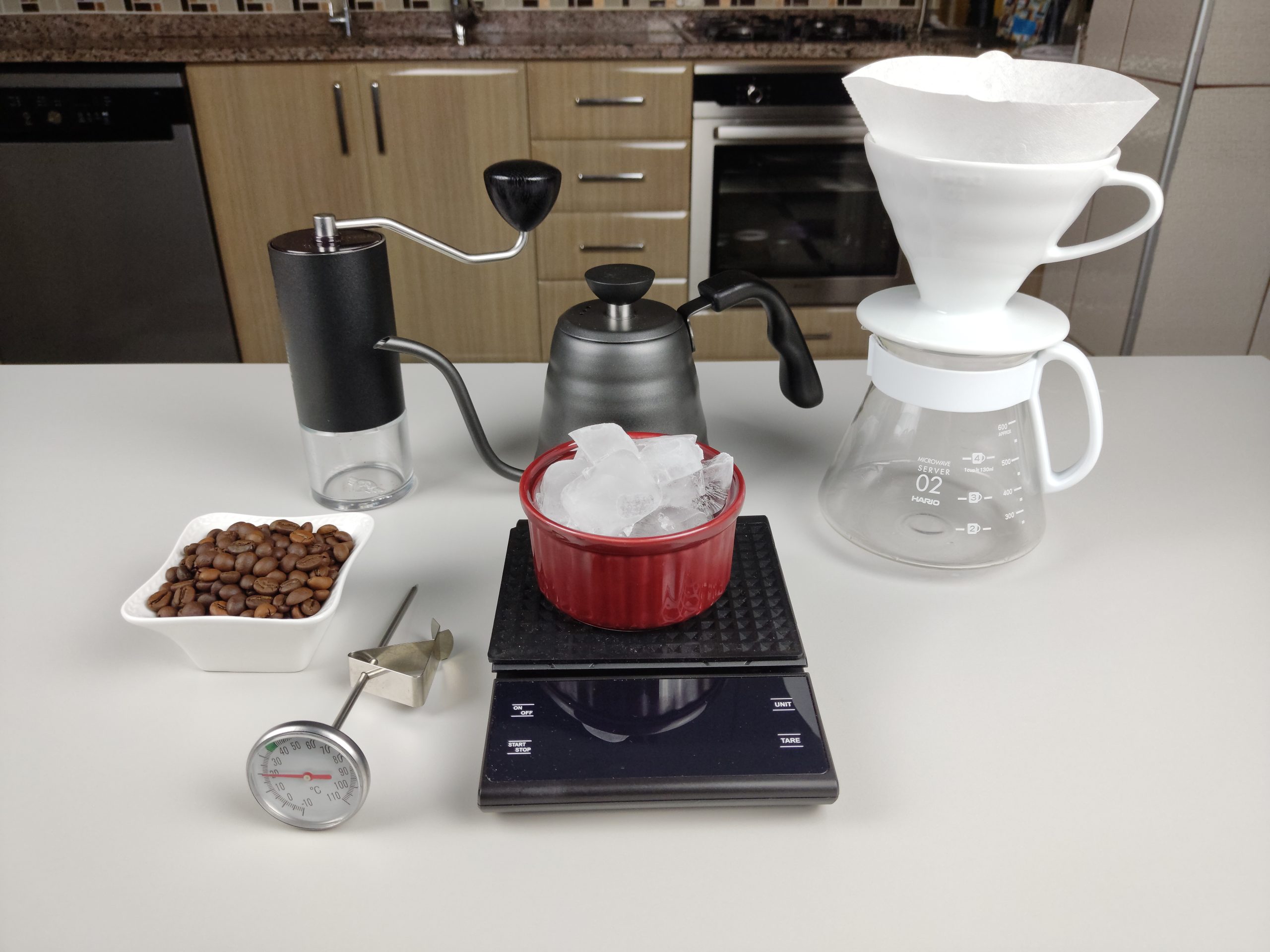
- Kettle
- Timer
- Scale
- Coffee Grinder
- Carafe
- Hario V60
- Hario V60 Filter
- Coffee Beans
- Water
- Ice
Step by Step Japanese Style Iced Coffee Recipe
To make Japanese iced coffee, you only need to brew coffee with hot water and pour it over a bed of ice. In this section, I’ll guide you through the steps to create this delicious drink and how to customize it to your taste preferences.
Note: You can use other brewing equipment besides the Hario V60 to make Japanese iced coffee at home. For example, Melitta, Kalita Wave, and Chemex are all suitable alternatives.
Note 2: Also, don’t forget to rinse your filter paper with hot water to ensure it adheres properly to your brewing equipment. With the Hario V60, you can easily do this by setting aside the decanter and using it for rinsing. Doing so can prevent the hot water used for rinsing from melting the ice in the decanter.
However, it’s worth mentioning that the Chemex doesn’t have a removable decanter like the Hario V60. Therefore, you’ll need to rinse the filter paper in the Chemex, which means the ice at the bottom won’t be spared from melting due to the hot water used for rinsing. As a result, it’s best to consider Chemex as a last resort for making Japanese cold brew.
Step 1: Calculation
In a standard pour-over brew, the coffee-to-water ratio is 1:16. However, the amount of water per unit of coffee should be slightly reduced for Japanese iced coffee. This is because some of the total water will be used not for brewing but for rapidly cooling down the coffee, which can reduce extraction. Therefore, more coffee should be used to compensate for this.
The ideal coffee-to-water ratio for Japanese iced coffee is 1:15. For each unit of coffee, you should use 15 units of water. For example, if you’re using 20 grams of coffee, you should use 300 ml of water.
Remember that some of the water used for brewing will come from the ice. In general, the hot water-to-ice ratio for Japanese iced coffee is 50%, meaning that the water-to-ice ratio is often 1:1. Using the 300 ml brew example means that 150 ml of the water should be liquid, and 150 ml should be ice.
If you notice that there is still a lot of ice left in the decanter after you’ve finished your coffee, you should use more hot water and less ice in your next brew. I recommend using more hot water whenever possible, as more hot water means more extraction. More extraction results in a more intense and aromatic coffee.
In conclusion, to find the perfect brewing formula for you, you can adjust the hot water-to-ice ratio in every brewing ritual. I use 60% hot water for my brews because using 50% hot water leaves too much ice in the decanter.
Step 2: Heat the Water
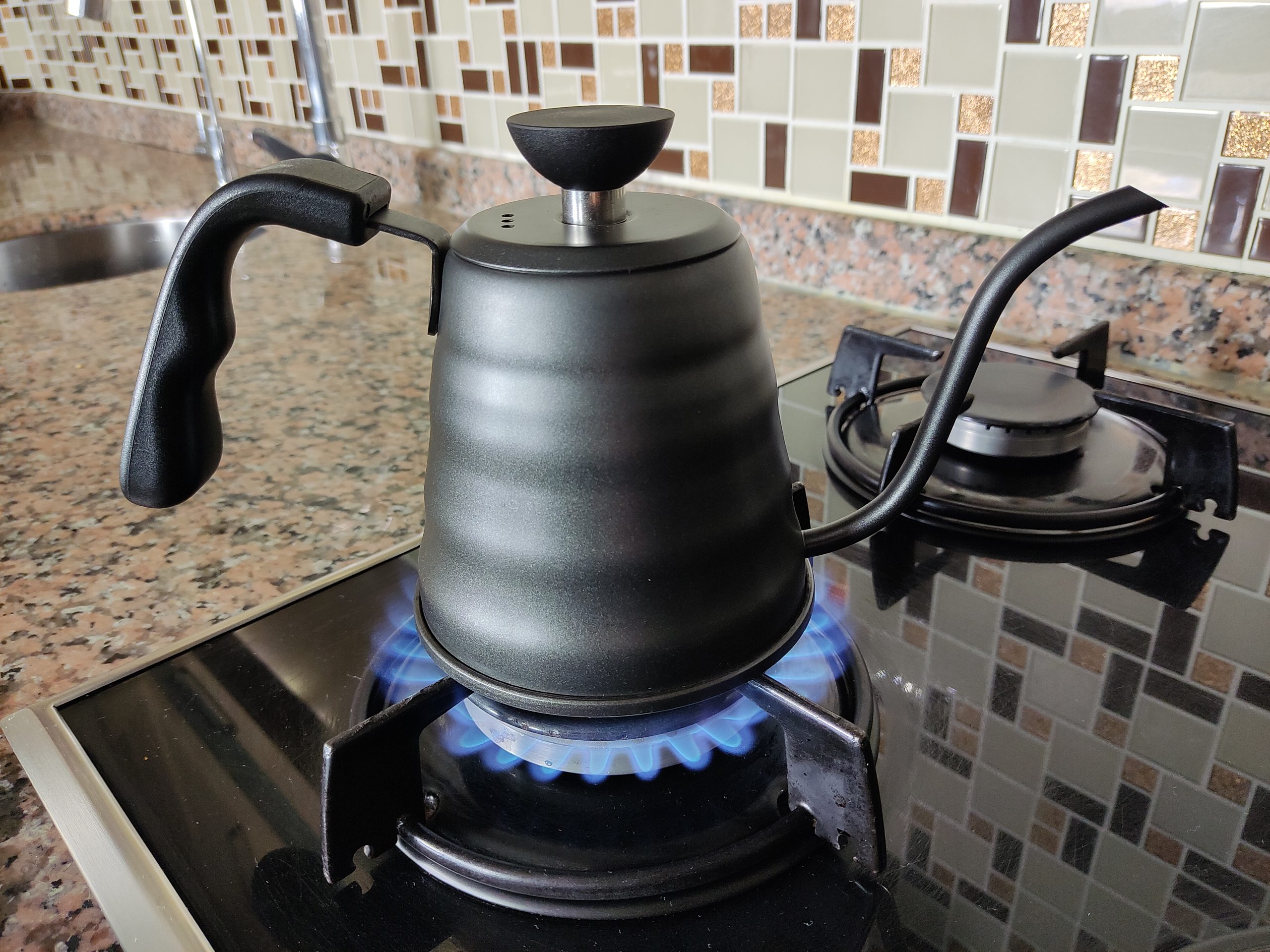
The ideal water temperature for Japanese iced coffee is just below the boiling point. If you have a thermometer, you can aim for 203°F (95°C). If you don’t have a thermometer, that’s not a problem. Simply boil the water, turn off the heat, and wait for 30 seconds.
For a more balanced brew, you can use a gooseneck kettle.
Step 3: Grind Your Coffee Beans
Note: You can skip this step if you’re using pre-ground coffee.
The ideal grind size for Japanese iced coffee is medium-fine. My recommendation for grinding is to go slightly finer than you would for other pour-over methods, as grinding your coffee beans more finely creates more surface area and leads to better extraction.
“But why don’t we grind all coffee beans as finely as possible?” you might ask.
The reason is that if you grind your coffee too finely, it can result in over-extraction, leading to bitter-tasting coffee.
So why must we use a slightly finer grind size for Japanese iced coffee?
Because some of the water used in Japanese iced coffee comes from the ice, less hot water is left to extract the coffee grounds. Using a slightly finer grind, you can reach the ideal level of extraction.
Step 4: Rinse Paper Filter
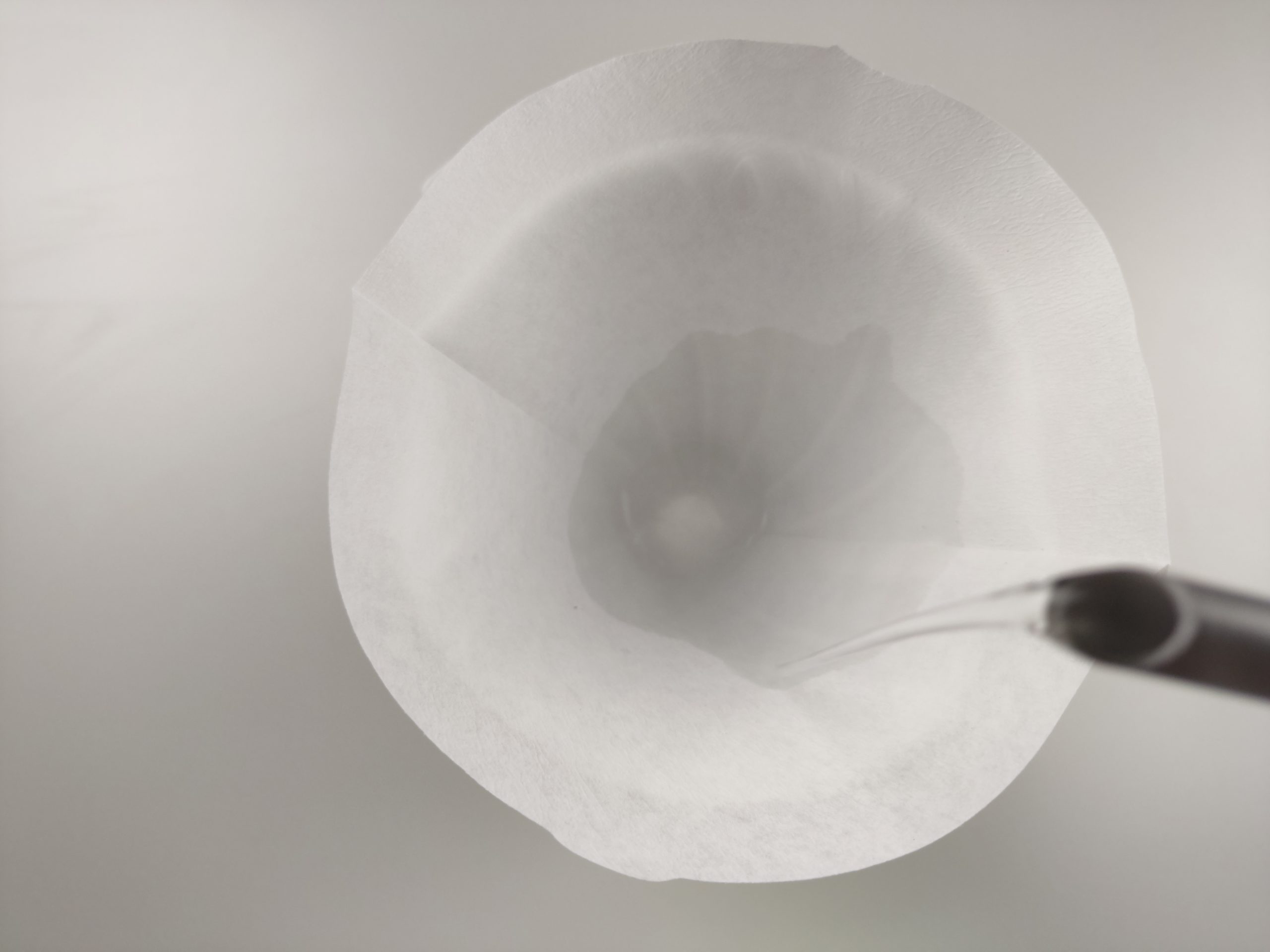
Place the paper filter in your V60 and rinse it with hot water. Remember to remove the V60 from the decanter while doing this, or the ice cubes will start melting at the wrong time. Also, sudden temperature changes can damage the V60’s glass.
Step 5: Add Coffee Grounds and Ice Cubes
Place the decanter on the scale and add the ice cubes. Then, add the coffee grounds to the V60 on top of the decanter. Take the tare weight of your scale.
Step 6: Bloom
Start the timer and add water for the bloom. The amount of water you need to add is one unit of water for one team of coffee grounds. For example, if you’re using 30 grams of coffee grounds, pour 60 ml of hot water over them.
Make sure that all of the coffee grounds are wet while adding water. Then, wait for 45 seconds.

Step 7: Pour the Remaining Water
After 45 seconds, pour the remaining water in a circular motion, slowly and evenly.

Step 8: Swirl
After pouring all of the water, swirl the V60 and decanter together lightly. This will help to mix all of the sludge and increase extraction.
Step 9: Serve
Wait for all the water to drain into the decanter, then separate the decanter from the V60. Give the decanter one final swirl to mix all the coffee, then serve with ice.

Final Thoughts on Homemade Japanese Iced Coffee
Japanese iced coffee is one of the most effective and convenient ways to make cold coffee at home. Try Japanese iced coffee if you don’t like the long wait time and relatively bland taste of cold brew coffee.
Don’t hesitate to adjust the coffee-to-water and water-to-ice ratios to find the best ratio for you. It’s hard to find a ratio that works for everyone, but you can find the best ratio for you through trial and error. Just remember to take notes on the ratios you use during your experiments. You can even share them with us in the comments below.
Related Recipes

Japanese Iced Coffee Recipe

Equipment
- 1 Timer
- 1 Scale
- 1 Coffee Grinder
- 1 Carafe
Ingredients
- 20 gr Coffee Beans
- 180 ml Hot Water
- 120 gr Ice Cubs
Instructions
- CalculationThe ideal coffee-to-water ratio for Japanese iced coffee is 1:15. For each unit of coffee, you should use 15 units of water. For example, if you’re using 20 grams of coffee, you should use 300 ml of water.Remember that some of the water used for brewing will come from the ice. In general, the hot water-to-ice ratio for Japanese iced coffee is 50%, meaning that the water-to-ice ratio is often 1:1. Using the 300 ml brew example means that 150 ml of the water should be liquid, and 150 ml should be ice.
- Heat the WaterThe ideal water temperature for Japanese iced coffee is just below the boiling point. If you have a thermometer, you can aim for 203°F (95°C). If you don’t have a thermometer, that’s not a problem. Simply boil the water, turn off the heat, and wait for 30 seconds.For a more balanced brew, you can use a gooseneck kettle.
- Grind Your Coffee BeansThe ideal grind size for Japanese iced coffee is medium-fine. My recommendation for grinding is to go slightly finer than you would for other pour-over methods, as grinding your coffee beans more finely creates more surface area and leads to better extraction.
- Rinse Paper FilterPlace the paper filter in your V60 and rinse it with hot water. Remember to remove the V60 from the decanter while doing this, or the ice cubes will start melting at the wrong time. Also, sudden temperature changes can damage the V60’s glass.
- Add Coffee Grounds and Ice CubesPlace the decanter on the scale and add the ice cubes. Then, add the coffee grounds to the V60 on top of the decanter. Take the tare weight of your scale.
- BloomStart the timer and add water for the bloom. The amount of water you need to add is one unit of water for one team of coffee grounds. For example, if you’re using 30 grams of coffee grounds, pour 60 ml of hot water over them.Make sure that all of the coffee grounds are wet while adding water. Then, wait for 45 seconds.
- Pour the Remaining WaterAfter 45 seconds, pour the remaining water in a circular motion, slowly and evenly.
- SwirlAfter pouring all of the water, swirl the V60 and decanter together lightly. This will help to mix all of the sludge and increase extraction.
- ServeWait for all the water to drain into the decanter, then separate the decanter from the V60. Give the decanter one final swirl to mix all the coffee, then serve with ice.