
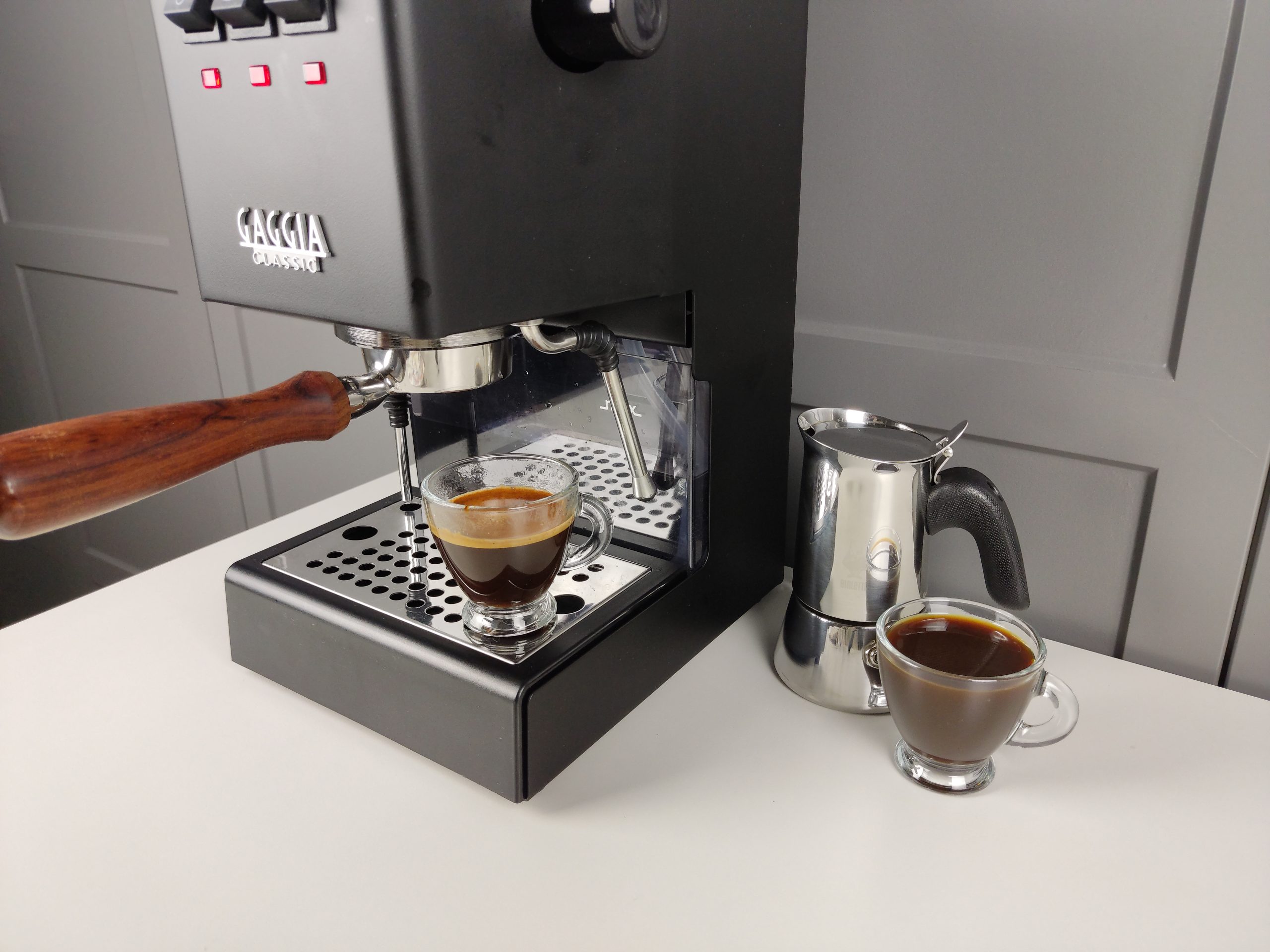

If you want to prepare a strong, intense, rich coffee at home, you can use a Moka pot coffee maker or an espresso machine.
Moka pot is generally known as a “substitute for an espresso machine.” It is known as one of the cheap alternatives to an espresso maker.
However, the situation is not exactly like this. Moka pot and espresso machine have many differences in various aspects.
In fact, the only common feature of Moka pot coffee maker and espresso machine may be that both make coffee 🙂
That is, both coffee makers have very different characteristics from each other.
Before addressing the topic in detail, let’s answer the most frequently asked question:
Does a Moka pot make espresso?
Quick answer: No, a moka pot cannot make espresso!
This article from Best Coffee at Home will discuss the similarities and differences between Moka pot and espresso machine.
Let’s start with our tiny friend, Moka pot, first.
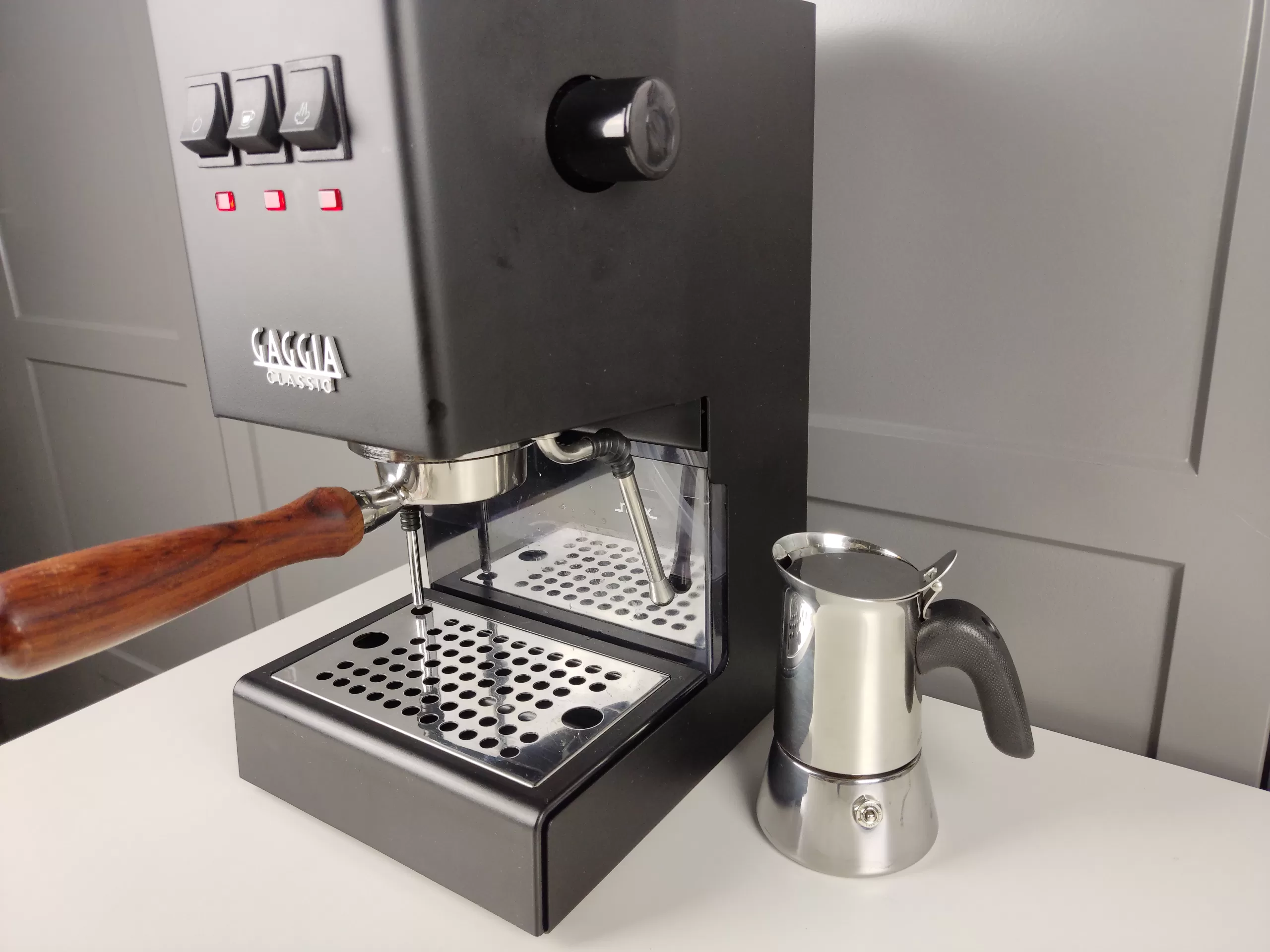
Related: Best Moka Pots of 2024, According to Expert Testing!
Moka Pot (Also Known as Stovetop Espresso Maker) 101
Moka pot was invented in 1933 by Alfonso Bialetti and quickly became one of the most iconic pieces of equipment in Italian cuisine. Over time, it spread throughout Europe and rest of the world. Today, Moka pot is one of the most popular coffee makers.
How Does a Moka Pot Work?
Before discussing how a Moka pot works, let’s identify its basic parts. Moka pot essentially consists of 3 main components. These are:
- Bottom chamber for brewed coffee
- A middle funnel-shaped section for coffee grounds
- Bottom chamber for water
A heat source heats the water placed in the bottom chamber. The heated water creates steam, which causes pressure in the bottom chamber. The hot water rises through the funnel-shaped section with the help of this pressure and meets the coffee. Here, the coffee that brews rises and pours into the top chamber, completing the brewing process.
The basic working principle of the Moka pot is as described. However, there are some nuances to brewing with a Moka pot. For all the information on using a Moka pot, you can check out our article “How to Use a Moka Pot?“
Espresso Machine 101
The first espresso machine was invented in 1884 by Angelo Moriondo, an Italian inventor from Turin. However, the modern espresso machine we know today was developed in the middle of the 20th century.
Today, there is a wide range of espresso machines in the coffee world/market, with many brands and different product models.
The first espresso machine was invented in 1884 by Angelo Moriondo, an Italian inventor from Turin. However, the modern espresso machine we know today was developed in the middle of the 20th century.
Today, there is a wide range of espresso machines in the coffee world/market, with many brands and different product models.
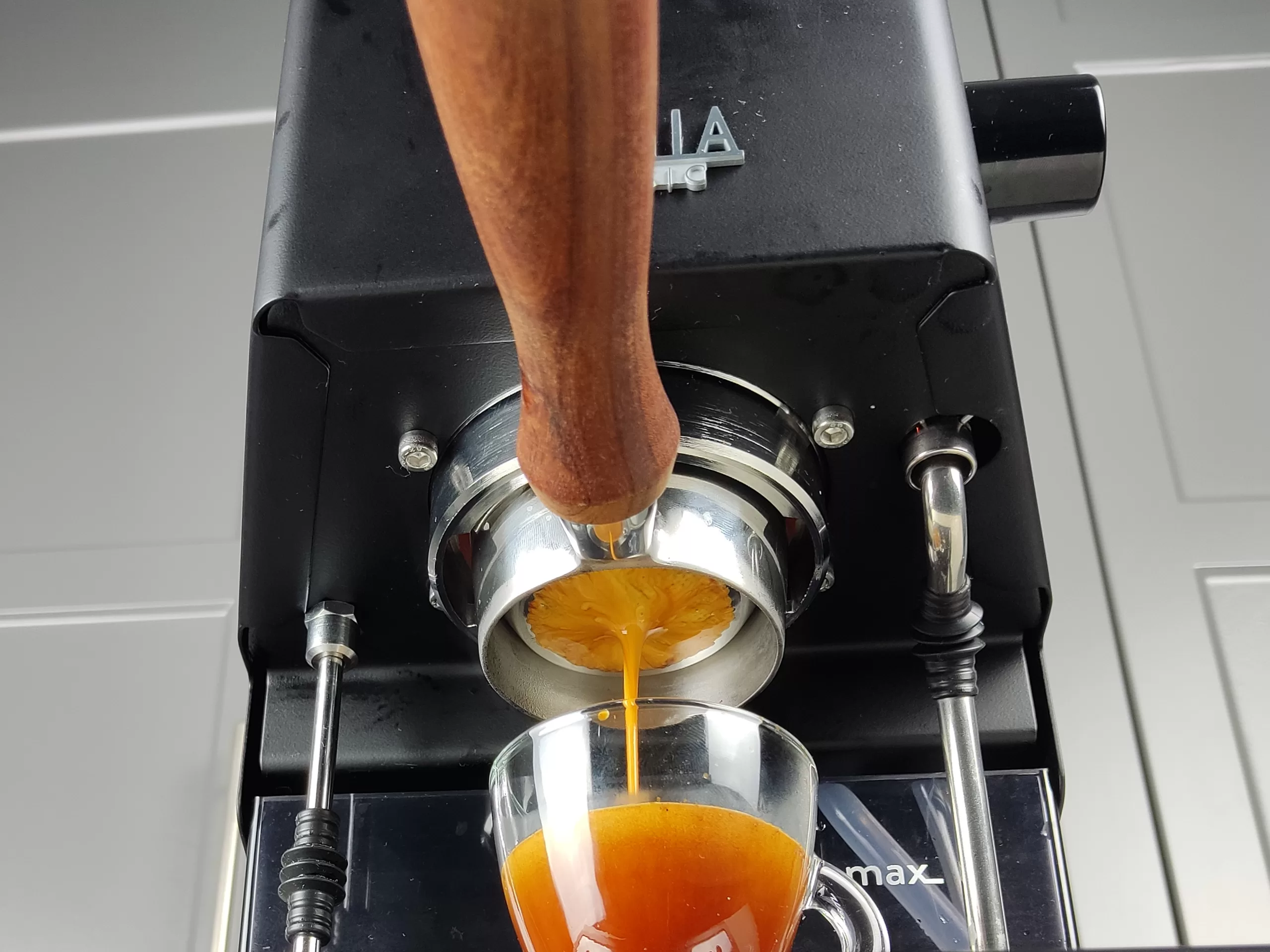
How Does an Espresso Machine Work?
Espresso machines consist of many parts and electronic components. An espresso machine consists of 4 main parts:
- boiler
- water pump
- group head
- portafilter
On the other hand, the working principle of espresso machines is simple.
- First, water is heated in the boiler to the appropriate temperature.
- Then, the hot water is pushed to the group head.
- The water reaching the group head passes through the coffee grounds in the portafilter under pressure. As a result, espresso is obtained.
Difference Between Moka Pot and Espresso Machine
Moka Pot | Espresso Machine | |
Ease of Use | Easy | Hard |
Brew Time | 2-3 min | 30 sec. |
Grind Size | Medium fine to fine | Fine |
Pressure | 1-2 bar | 6-15 bar |
Crema | No | Yes, thick and creamy |
Maintenance | Easy | Medium |
Portability | Compact and easy to carry | Often bulky and not easy to transport |
Price Range | Inexpensive | Can range from moderate to very expensive |
Ease of use: Moka Pot vs. Espresso Machines
Moka pots are generally easy-to-use coffee makers. This is because the amount of water you can use in a moka pot is clearly defined. All that remains is to grind your coffee beans suitably for moka pot and to set the temperature of your heat source correctly.
Using espresso machines is not as easy as using a moka pot, as they have many more variables.
For example, espresso you make when you first get your coffee beans will taste different from espresso you make a week later. This is because the CO2 content in the beans decreases once the package is opened.
Let’s give another example:
If you put half a gram more or less coffee in the portafilter for the espresso machine than usual, use coffee beans of a different roast level, or make the slightest adjustment to your coffee grinder, the taste of your espresso will change significantly.
So, making the same standard espresso every day requires skill. However, the same is not true for a moka pot. The coffee-water ratio in a moka pot is fixed and has fewer variables than espresso. Therefore, even if you make mistakes in the brewing stages with a moka pot, your coffee will not be much affected.
In conclusion, when comparing the ease of use of espresso machines and moka pots, moka pot has a simpler usage.
Brew Time: Stovetop vs Espresso Machine
The brewing time in a Moka pot takes approximately 2-3 minutes. So, excluding a few minutes of preliminary preparation, like grinding the coffee and preheating the water, you can prepare a cup of Moka pot coffee in 2-3 minutes.
Getting a shot of espresso from an espresso machine takes about 25-30 seconds. (This duration does not include the time taken to heat the machine, weigh the coffee, and use extra equipment like distributor and WDT tools.)
In conclusion, an espresso machine has a much shorter extraction time than a Moka pot. Therefore, preparing coffee in an espresso machine takes less time than in a Moka pot.
Grind Size for Moka Pot and Espresso Machine
The grind size for Moka pots and espresso machines is quite different. The ideal grind size for coffee beans for a Moka pot is between medium-fine and fine, while for espresso machines, the ideal grind size is fine.
A coarser grind is used in stovetop espresso pots compared to classic espresso machines. One of the main reasons for this is the difference in pressure generated during brewing between the two machines. Espresso machines operate at a much higher pressure compared to Moka pots.
So, what does the pressure difference between Moka pots and espresso machines have to do with the grind size of coffee beans?
Let me explain!
The finer the coffee is ground, the more difficult it is for water to pass through the coffee grounds. In Moka pots, a coarser grind is used to reduce the resistance faced by water.
Otherwise, the pressure achievable by Moka pot will not be enough to overcome the resistance created by the coffee grounds, and brewing will not occur. Alternatively, brewing might occur, but if the grind is finer than it should be, the coffee may suffer from over-extraction, resulting in bitter flavors.
This situation is also true for espresso machines. In the reverse situation, when a grind is coarser than it should be for an espresso machine, the water will pass through the portafilter too quickly. Consequently, the brewing time will decrease, and an under-extracted coffee will be produced, resulting in a sour taste.
How Many Bars of Pressure Are Good for a Moka Pot and Espresso Machine?
Both stovetop espresso pots (Moka pots) and espresso machines operate using pressure, but the methods of generating this pressure and the magnitudes of the pressure differ.
The 1-2 bars of pressure in a Moka pot are achieved by heating the water in the bottom chamber. Thus, stovetop espresso pots typically generate 1-2 bars of pressure.
Espresso machines, on the other hand, use an electric pump to create pressure. The pressure used in espresso machines can vary depending on the brand and model, but it is typically between 6 and 15 bars. Most espresso machines are designed to produce around 9 bars of pressure.
In summary, espresso machines operate at significantly higher pressure than Moka pots. Moreover, this pressure difference is a fundamental reason for the taste difference between coffee made in a Moka pot and an espresso machine. The high pressure in espresso machines provides a rich and thick crema layer on the espresso, which the pressure produced by a Moka pot is insufficient to achieve.
Taste and Texture of Moka Pot Coffee and Espresso
Moka pot and espresso machine make rich, strong, concentrated coffee. However, the difference in taste and texture is quite obvious when compared.
Espresso is richer, stronger, and more concentrated than coffee brewed in a Moka pot. It also has a higher caffeine concentration. The primary reason for this lies in the coffee-water ratio of espresso.
To better understand the coffee-water ratio’s impact on coffee’s taste and texture, let’s make a comparison.

Coffee-Water Ratio for Filter Coffee, Moka Pot, and Espresso:
- Filter coffee: 1:16
- Moka pot: 1:10
- Espresso: 1:2
For every unit of coffee, filter coffee uses 16 units of water, a Moka pot uses 10 units, and an espresso machine uses 2 units. This difference directly affects the coffee’s intensity, richness, and caffeine content.
Therefore, espresso is brewed 8 times more concentrated than standard filter coffee and 5 times more concentrated than coffee from a Moka pot. Moka pot sits in the middle regarding the concentration between espresso and filter coffee.
Maintenance and Cleaning
Espresso machines and Moka pots should be cleaned regularly after each use, and periodic maintenance/deep cleaning should be done.
After each use, a stovetop espresso maker (Moka pot) should be rinsed with water, and any accumulated limescale should be cleaned regularly.
On the other hand, after cleaning Moka pot, ensure it is dried properly and that the accumulated limescale does not hinder the operation of the safety valve.
You should also periodically check whether the gasket has reached the end of its life. You can check our guide “How to Clean a Moka Pot?” for a complete guide to cleaning a Moka pot.
In the case of espresso machines, you should clean the group head and portafilter after each use. The steam wand should be wiped immediately after use; otherwise, the milk sticking to it will cause trouble later on.
Additionally, depending on the hardness of the water used in your espresso machine, you should perform limescale cleaning at certain intervals. Descaling espresso machines requires a bit more effort than Moka pots, as it’s not easy to open and clean the machine’s internal components.
Drinks You Can Make with an Espresso Machine and Moka Pot
Espresso is considerably more concentrated than coffee brewed in a Moka pot. Therefore, espresso is often used as a base in many coffee recipes.
For example, many of the coffees you see at Starbucks use espresso as a base. This means that when you buy an espresso machine, you can make many of the coffees you enjoy at Starbucks in your home.
What can you make at home with an espresso machine?
- Hot or Iced Americano
- Americano misto
- Americano with milk
- White Americano
- Long Black
- Red eye, dead eye, black eye
- Macchiato
- Latte
- Cappuccino
- Flat white
- Mocha
Note: You can also make espresso-based coffees with coffee brewed in a Moka pot. However, Moka pot will not give the same taste as espresso because it cannot brew coffee as concentrated as an espresso machine.
Portability
Moka pot is a very suitable coffee maker for travel. In particular, 6-cup Moka pot models are quite portable in size. Moka pot is also durable against impacts due to its sturdy construction. The only disadvantage of Moka pot for travel is the need for a heat source.
On the other hand, portable espresso machines like the Wacaco Nanopresso can be used with just hot water, without any heat source.
Therefore, when you are away from home, you need to find a heat source to make Moka pot coffee. You can prepare an espresso shot using hot water with portable espresso machines.
Price Comparison
Moka pots can be purchased at quite affordable prices. A typical Moka pot costs between $30-$60. The prices of quality espresso machines generally start at around $500.
Which One is Best For You: a Moka pot or Espresso Machine
If you read this article just to learn about the differences between Moka pots and espresso machines, I can say that you now completely understand the subject. However, if you are in the buying phase and still can’t decide which one to choose, let’s talk a bit more!
Firstly, if you have an espresso machine at home, you can make many coffees sold in coffee shops.
However, if you don’t have enough budget for an espresso machine and like coffee with a taste similar to espresso, you can opt for a Moka pot. If you decide to buy a Moka pot, you can go to a third-wave coffee shop and taste Moka pot coffee. This way, you will know beforehand what kind of coffee Moka pot will provide you.
Note: Although Moka pot coffee tastes similar to espresso, they differ significantly. So, the taste profiles of the coffee both coffee makers produce differ. But we are not saying this in a good or bad way. You may like the taste of Moka pot coffee more or less than espresso.
If you want to drink coffee with a taste almost identical to espresso and have a budget under $100, you can try portable espresso machines. If you want a coffee with a similar intensity to espresso using a Moka pot, you can buy an Aeropress for $30-$50 and try espresso with Aeropress.